Key Takeaways
- Stability of raw materials pre-extrusion can be variable, impacting finished product nutrient levels
- Inclusion of 0.25% Oxy-Gon® powder to a vitamin premix improved stability of thiamine under accelerated shelf-life conditions for 9 weeks
- Selectively incorporating antioxidants into raw materials extends shelf life and ensures formulation accuracy
+AOX, vitamin premix with addition of Oxy-Gon® powder at 0.25% inclusion; AAFCO, Association of American Feed Control Officials; AOX, Antioxidant; -AOX, Vitamin premix without addition of Oxy-Gon® powder; CEN, Comité Européen de Normalisation; FEDIAF, Fédération Européenne de l'Industrie des Aliments pour Animaux Familiers; HPLC, High Performance Liquid Chromatography; NADH, Nicotinamide Adenine Dinucleotide + Hydrogen; NRC, National Research Council; ROS, Reactive Oxygen Species; USP, United States Pharmacopeia
Antioxidant Use in Pet Food
Antioxidants (AOX) are widely used in pet food to prevent oxidative degradation of nutrients, maintain product quality, and extend shelf life1. In both dry and wet formulations, AOX inhibit the oxidation of lipids, vitamins, and other oxidation-sensitive components which can lead to off-flavors, color changes, and nutrient loss. In addition to protecting lipids, AOX indirectly preserve water-soluble vitamins by reducing the formation of reactive oxygen species (ROS) and secondary oxidation products that would otherwise catalyze vitamin degradation2. Proper selection, inclusion level, and homogeneous distribution of AOX are critical to ensuring both nutrient stability and sensory quality throughout processing, packaging, and storage.
While AOX are commonly used in particularly labile raw materials, such as animal-derived meats and various oils, they are less commonly used in other raw materials that could benefit from reduced degradation and preservation of quality. Vitamin and mineral premixes are universally used in extruded pet foods to ensure sufficient essential micronutrient delivery. While an integral component of nearly all formulations, there is significant risk of nutrient degradation during storage that can compromise the quality of the finished product, even prior to processing. There is an opportunity for AOX systems to be applied to dry vitamin and mineral premixes to preserve formulated levels of these micronutrients. One such vitamin of particular interest for preservation is thiamine.
Thiamine
A water-soluble essential vitamin, also known as vitamin B1, thiamine has been identified as one of the least stable of the water-soluble vitamins. Thiamine plays several critical roles in the healthy function of dogs and cats3. It is an essential cofactor in carbohydrate metabolism, production of nucleotides and Nicotinamide Adenine Dinucleotide + Hydrogen (NADH), and nervous system function. As dogs and cats are incapable of producing this vitamin endogenously, it must be provided at adequate levels in the diet4. There is no established safe upper limit, and requirements differ between dogs and cats while remaining relatively consistent across regulatory bodies (Table 1).Table 1. Thiamine minimum recommended allowance (RA) for dogs and cats in mg/kg DMB established by the Association of American Feed Control Officials5 (AAFCO, 2026), the National Research Council4 (NRC, 2006) and the Fédération Européenne de l'Industrie des Aliments pour Animaux Familiers6.
| Thiamine RA | AAFCO | NRC | FEDIAF |
| Dog, mg/kg DMB | 2.25 | 2.25 | 2.1-2.5 |
| Cat, mg/kg DMB | 5.6 | 5.6 | 4.4-5.9 |
Thiamine Losses During Production
Thiamine losses during heating and extruding are well documented7 with reports of up to 90% destruction of thiamine during these processes5. To reduce the need for excessive inclusion of thiamine in formulations to meet requirements, it is imperative to attempt to maintain the highest levels of thiamine possible in base mixtures. As such, the objective of this current study was to evaluate the efficacy of Oxy-Gon® powder, a blend of various natural AOX, in stabilizing thiamine concentrations in a vitamin premix exposed to accelerated shelf-life testing conditions. We hypothesized that Oxy-Gon® powder would maintain thiamine concentrations over the 9-week period compared to a control sample of the same vitamin premix exposed to the same conditions.Materials and Methods
To begin, two pounds of vitamin premix were prepared. One one-pound sample, the control, was packed in a foil bag. The second one-pound sample was mixed with 1.135 g of Oxy-Gon® powder, to achieve a 0.25% inclusion rate, for 3 minutes with a benchtop mixer before being packed into a foil bag. Both control (-AOX) and treatment (+AOX) foil bags were placed in an incubator set to 40 °C to simulate accelerated aging conditions.At weeks 0, 3, 6, and 9, 25 g samples of both +AOX and -AOX were collected and analyzed by Eurofins Scientific for thiamine content by High Performance Liquid Chromatography (HPLC) in accordance with United States Phamacopeia (USP) and European Norm of the Comité Européen de Normalisation (CEN) methodologies. Under accelerated conditions, these four sampling timepoints align with 0, 3, 6, and 9 months of ambient storage conditions.
Results and Discussion
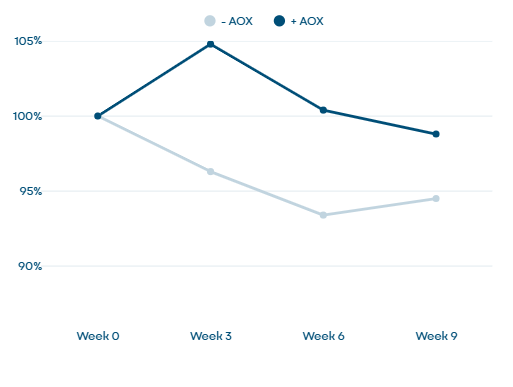
Thiamine concentrations in the vitamin premix over 9 weeks of storage at 40 °C are presented in Figure 1. Over time, −AOX showed a progressive decline in thiamine retention, decreasing to 96.3% at week 3, reaching a minimum of 93.4% by week 6, and increasing slightly at week 9 to 94.5%. In contrast, +AOX demonstrated improved stability, with a transient increase above baseline at week 3 (104.8%), followed by modest decreases to 100.4% at week 6 and 98.8% at week 9. When week 9 thiamine concentrations were compared to baseline (week 0), thiamine loss in -AOX and + AOX were calculated to be 5.5% and 1.2%, respectively.While it is unclear why thiamine concentrations in the +AOX premix increased at weeks 3 and 6 compared to baseline, there is a clear difference between the thiamine content across time in both groups. In the -AOX premix, thiamine steadily declined over time, while in the +AOX premix, it appears to remain close to the baseline value, aligning with our initial hypothesis. Overall, inclusion of Oxy-Gon® powder resulted in consistently higher thiamine retention compared with the control, suggesting a protective effect against thiamine degradation during accelerated thermal storage. These results support further evaluations of the inclusion of Oxy-Gon® powder in raw materials to maintain quality and nutrient levels prior to processing, particularly with raw materials, such as vitamin and mineral premixes, where only a small quantity is needed at one time and much of the lot will remain in storage for some time.
Figure 1. Percent Thiamine Retention in a vitamin premix with 0.25% inclusion of Oxy-Gon® powder (+AOX) and the same vitamin premix without addition of Oxy-Gon® powder (-AOX) at 3, 6, and 9 weeks of incubation at 40 °C to simulate ambient storage at 3, 6, and 9 months.
Optimize Your Pet Food Formulations with Oxy-Gon®
Ready to enhance your pet food stability and quality?
Contact Rangen Pet Nutrition today to learn how Oxy-Gon® can revolutionize your oxidation control strategy.
Works Cited
1.Halliwell B, Gutteridge JMC. Free radicals in biology and medicine. 3rd ed. Oxford, UK: Clarendon Press; 1999.
2.Barden L, Decker EA. Lipid oxidation in low-moisture foods: A review. Crit Rev Food Sci Nutr. 2016;56:2467–2482.
3.Kritikos G, Parr JM, Verbrugghe A. The role of thiamine and effects of deficiency in dogs and cats. Vet Sci. 2017;4(4):59. doi:10.3390/vetsci4040059.
4.National Research Council. Nutrient requirements of dogs and cats. Washington (DC): National Academies Press; 2006. Vitamins; p. 193–245.
5.Association of American Feed Control Officials (AAFCO). AAFCO official publication. West Lafayette (IN): AAFCO Inc.; 2026.
6.FEDIAF. Nutritional guidelines for complete and complementary pet food for cats and dogs. Brussels, Belgium: European Pet Food Industry Federation; 2021.
7.Coelho M. Vitamin stability in premixes and feeds: A practical approach in ruminant diets. In: Proceedings of the 13th Annual Florida Ruminant Nutrition Symposium; 2002 Jan 11–12; Gainesville, FL, USA. p. 127–145.